
United States Ten-Year Treasury Yields Breach Five Percent Amid Inflation and Supply Shocks


September 15, 2026 – The United States ten-year Treasury yield surged past the five percent threshold on Monday, reaching its highest intraday level since October 2023. This massive upward repricing across the global benchmark borrowing rate directly stems from escalating crude oil prices and persistently sticky inflation data.
Institutional bond investors are aggressively selling long-duration sovereign debt as probability models indicate the Federal Reserve will resume interest rate hikes this week.
Compounding this macroeconomic friction, the Treasury market is absorbing a massive surge in bond supply driven by expanding federal budget deficits and artificial intelligence corporate borrowing.
For macroeconomic allocators, this structural shift in the forward yield curve fundamentally threatens the relative valuation of equity markets by offering highly competitive risk-free returns.
Energy Shocks and Inflationary Pressures
The primary catalyst driving this sudden fixed-income selloff is the rapid escalation in global energy costs. Brent crude futures recently surged toward 108 USD per barrel following severe infrastructure disruptions across critical Saudi Arabian pipelines.
This localized energy shock immediately translates into higher consumer and producer price indices, severely complicating the monetary policy outlook for the Federal Reserve.
With inflation metrics already running well above the two percent annualized target, fixed-income desks anticipate a hawkish policy response from Washington.
Derivatives markets currently assign a probability exceeding 92 percent that the central bank will execute a rate hike during its upcoming policy meeting.
Debt Issuance and Fiscal Deficits
Beneath the immediate monetary pressures, the bond market is struggling to absorb unprecedented volumes of new debt issuance.
The United States federal budget deficit recently approached two trillion USD, forcing the Treasury Department to flood the market with sovereign paper.
Simultaneously, major technology conglomerates are executing massive corporate bond sales to finance their highly capital-intensive artificial intelligence data centers.
This dual wave of public and private supply structurally depresses bond prices, forcing yields mechanically higher to attract sufficient institutional capital.
Quantitative analysts note that investors are now demanding a higher term premium to hold long-duration assets against this deteriorating fiscal backdrop.
Equity Multiples and Capital Rotation
From a market positioning standpoint, a five percent risk-free yield creates immediate structural friction for global equity valuations. Higher borrowing costs directly increase the weighted average cost of capital for multinational corporations, squeezing forward operating margins.
Trading desks observe that algorithmic models are actively rotating capital away from growth-oriented technology stocks and into defensive, high-yield sovereign debt.
This capital rotation was highly visible during Monday trading, as major equity indices contracted while capital flowed toward short-duration cash equivalents.
Unless the Federal Reserve provides explicit dovish forward guidance, institutional allocators project that the ten-year yield will remain firmly anchored near this psychological resistance zone.
Read more
 Brent Crude Climbs to 96 USD as Escalating U.S.-Iran Tensions Threaten Maritime Chokepoints
September 4, 2026 – Global crude benchmarks violently reversed their late-summer slump this week, with Brent crude briefly piercing the 96 USD per barrel threshold.The aggressive rally is entirely driven by a massive injection of geopolitic…
Donia Saad•04 September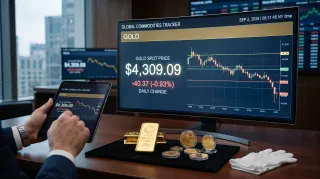 Gold Tests 4,300 USD as Hawkish Warsh Speech Sparks September Rate Hike Bets
September 2, 2026 – Spot gold (XAU/USD) is facing severe downward pressure this week, decisively breaking below the 4,400 USD threshold to test critical support near 4,300 USD.The aggressive selloff was triggered by a highly hawkish keynote…
Donia Saad•02 September U.S. Inflation Eases to 3.4% as Core PCE Stickiness Complicates Kevin Warsh’s Next Fed Move
August 26, 2026 – U.S. inflation data provided a mixed relief to financial markets this week, as the headline Consumer Price Index (CPI) cooled to 3.4% year-over-year in July.While the slight deceleration from June’s 3.5% offers temporary b…
Donia Saad•26 August Gold Spot Prices Near $4,346 as Rising Bond Yields Challenge Bullion Rally
August 19, 2026 – Spot gold prices pulled back slightly to trade near $4,346.13 per ounce during recent market sessions, as a sudden surge in global sovereign bond yields created a fresh macroeconomic drag on precious metals.The modest decl…
Donia Saad•19 August S&P 500 Pulls Back 0.7% as Rising Treasury Yields and Geopolitical Tensions Squeeze Tech Leaders
August 19, 2026 – The S&P 500 index declined 0.7% to close near 6,432 points during Tuesday's trading session, extending a three-day pullback from its recent record highs.The broader market retreat was fueled by a sharp rise in global bond…
Donia Saad•19 August Dow Jones Index Slips Over 270 Points as Bond Yields and Oil Prices Pressure Wall Street
August 18, 2026 – The Dow Jones Industrial Average shed over 270 points to close near 53,460 during recent trading, interrupting its mid-month ascent.The blue-chip index pulled back from multi-week highs as a fresh surge in U.S. Treasury yi…
Donia Saad•18 August Dollar Holds Firm as Oil Surge Revives Rate Fears
 On May 18, 2026, the dollar steadied as soaring oil prices and a deepening bond selloff revived fear of tighter global monetary policy. Traders also tracked renewed weakness in the yen as intervention risks resurfaced. Dollar Steady as Oi…
UA Finance•18 May Fed Warns Oil Shock Threatens Financial Stability
 On May 8, 2026, the Federal Reserve warned that rising geopolitical risks and the oil shock linked to Middle East tensions are rapidly becoming major threats to financial stability and inflation control. Oil Shock Climbs to Top of Fed’s R…
UA Finance•09 May Markets Adjust Rates as Oil Price Surge Changes Outlook
 Global markets revised their outlook on March 20, 2026, as oil prices jumped and central banks signaled tighter monetary policy. The rising energy costs and geopolitical tensions are fueling inflation fears and affecting interest rates wo…
UA Finance•24 March Fed Shock: Rate Hike Back on the Table
“Fed Signals Possible Shift Toward Rate Hike Again” captures the sudden shift in expectations on Saturday, March 21, 2026. The Federal Reserve is sending a message of uncertainty. The main drivers of a rate hike are inflation, geopolitical…
UA Finance•22 March