
Oracle (ORCL) Braces for High-Stakes Earnings as Massive 638 Billion USD AI Backlog Clashes with Free Cash Flow Panic


September 7, 2026 – Shares of Oracle Corporation (ORCL) are trading with extreme implied volatility as institutional capital braces for the company’s pivotal fiscal first-quarter earnings report on Thursday, September 10.
The cloud and database giant finds itself at a historic fundamental crossroads, caught between unprecedented artificial intelligence demand and severe balance sheet deterioration.
While the stock recently bounced off its 2026 low of 114 USD, it remains roughly 40% below its summer highs following a brutal credit downgrade by S&P Global Ratings.
Wall Street trading desks are demanding immediate proof that Oracle can convert its generational AI pipeline into positive cash flow before its aggressive data center expansion permanently fractures its investment-grade credit rating.
The 638 Billion USD Backlog vs. Capital Burn
The core institutional debate surrounding Oracle centers entirely on the cost of its artificial intelligence growth.
During its last financial update, management revealed that its contracted remaining performance obligations (RPO) had skyrocketed to a staggering 638 billion USD, driven by massive hyperscale and enterprise AI contracts.
However, to service this monumental backlog, Oracle has embarked on an unprecedented infrastructure spending spree.
Full-year capital expenditures exploded by 162% to hit 55.7 billion USD, effectively dragging the company’s free cash flow down to a catastrophic negative 23.7 billion USD.
For asset managers, the question heading into Thursday’s report is not whether Oracle’s AI business is growing, but rather how much capital the company must burn to physically build the data centers required to capture that growth.
Credit Downgrades and Financing Headwinds
The severity of Oracle’s cash burn triggered a fierce institutional selloff in July after S&P Global Ratings stripped a notch off the company's credit rating, cutting it to BBB-.
This downgrade pushed Oracle's rating to just one step above junk status, forcing the credit default swap market to price in elevated default probabilities.
The company raised 43 billion USD in debt and 5 billion USD in equity last year, and management has outlined plans to secure an additional 40 billion USD in capital to fund further AI infrastructure.
Despite these severe financing headwinds, the underlying demand profile remains pristine, heavily insulating the stock from a complete structural collapse.
Wall Street analysts broadly maintained their price targets throughout the selloff, arguing that the market is simply repricing Oracle's financing risk rather than downgrading its core software and cloud enterprise metrics.
Earnings Expectations and Technical Outlook
Heading into the September 10 earnings release, consensus estimates project fiscal Q1 revenue to jump 28.3% year-over-year to 19.1 billion USD.
Adjusted earnings per share are expected to rise 18.5% to 1.74 USD, providing a robust top-line growth narrative.
From a technical perspective, ORCL recently reclaimed its 50-day moving average, signaling a near-term bullish recovery from the mid-130 USD resistance levels.
However, the longer-term chart remains structurally cautious, with immediate overhead resistance heavily defended by algorithmic short-sellers near the 170 USD threshold.
If management can demonstrate stabilizing gross margins and narrowing cash burn on Thursday, analysts expect aggressive short-covering to violently drive the equity back toward the 200 USD parity zone.
Read more
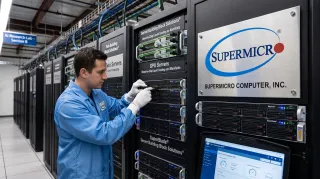 Super Micro Nears 40 USD as Record 60 Billion USD AI Backlog Overpowers Dilution Panic
September 6, 2026 – Shares of Super Micro Computer (SMCI) are staging a fierce late-summer recovery, pushing back toward the 40 USD threshold.Institutional capital is actively buying the dip after a chaotic August trading month that saw the…
Donia Saad•06 September Alphabet (GOOGL) Holds 335 USD as Federal Judge Dismisses Ad-Tech Breakup Bid
September 2, 2026 – Shares of Alphabet Inc. (GOOGL) consolidated near 335.02 USD on Wednesday, successfully defending critical technical support following a monumental regulatory victory.Institutional capital aggressively defended the equit…
Donia Saad•02 September Amazon (AMZN) Holds 261 USD as a 220 Billion USD AI Infrastructure Buildout Swallows Free Cash Flow
August 26, 2026 – Shares of Amazon.com Inc. (AMZN) demonstrated remarkable resilience this week, holding steady near 261.91 USD and outperforming broader megacap technology peers.While retail commentators remain fixated on the company's agg…
Donia Saad•26 August Microsoft Shares Fall 3% to $480 as Wall Street Weighs Soaring AI Infrastructure Capex
August 18, 2026 – Microsoft Corporation (MSFT) equity shares declined 3.04% to close near $480.35 during recent trading, interrupting a mid-month recovery toward the $500 milestone.The fresh pullback reflects renewed market anxiety over the…
Donia Saad•18 August Global Investors Reassess AI Spending as Big Tech Earnings Raise Questions Over Returns
July 26, 2026 – Investor sentiment towards artificial intelligence is entering a new phase as markets increasingly demand measurable financial returns rather than continued expansion in AI spending. Recent earnings from major technology com…
Donia Saad•26 July Tech Companies Turn to Debt Markets to Fund AI and Cloud Expansion
Tuesday, March 10, 2026 – 09:40 AM – Source: Reuters Why Are Tech Giants Turning to Debt to Fund AI Growth? Major technology companies are increasingly turning to debt markets to finance their ambitious investments in artificial intelligenc…
UA Finance•22 March Big Tech Turns to Debt Markets to Finance AI and Cloud Expansion
Tuesday, March 10, 2026 – 09:40 AM – Source: Reuters Why Is Big Tech Borrowing Billions to Fuel AI Growth? The race to dominate artificial intelligence is becoming increasingly expensive, and major technology companies are turning to new fi…
UA Finance•19 March Oracle Launches Massive Bond Sale to Finance AI Infrastructure Expansion
Sunday, February 2, 2026 – 10:15 AM – Source: Bloomberg Why Is Oracle Raising Billions to Accelerate Artificial Intelligence Expansion? Artificial intelligence is reshaping the technology industry, and major companies are investing heavily…
UA Finance•17 March Oracle Raises $25 Billion to Accelerate AI Data-Center Expansion
Sunday, February 2, 2026 – 10:00 AM – Source: Bloomberg Why Is Oracle Raising Billions to Power the Future of Artificial Intelligence? Artificial intelligence is driving a massive wave of investment across the global technology industry, an…
UA Finance•17 March Oracle’s Biggest Focused on Risk
Oracle’s Biggest Earnings Challenge Is a Market Focused on Risk According to Oracle Corp., the company’s biggest challenge as it approaches its earnings report is to prove to investors that its significant investments in AI infrastructure a…
UA Finance•11 March