
Understanding Stock Market Volatility and How to Handle It


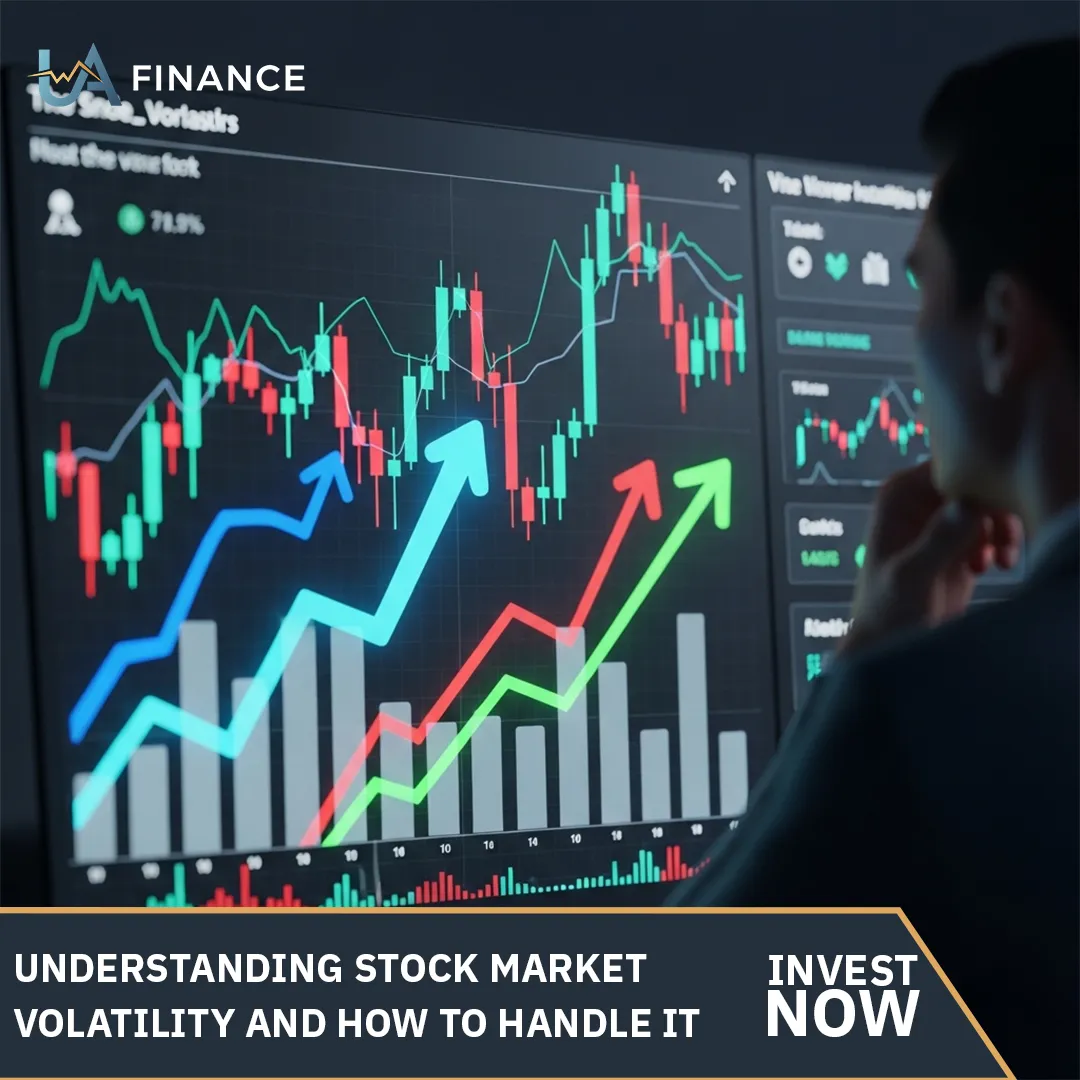
Volatility is an investment term describing market or security price movements over time periods, including sharp increases or decreases, or unpredictable fluctuations, while people tend to think of volatility only when prices fall
Risk vs opportunity
Serving as a double-sided blade with increased risk of loss and opportunity for profits, triggering emotional selling accompanied by portfolio decline, which in turn offers long-term investors the opportunity to buy quality assets at lower prices for higher gains:
The downside:
- Loss potential: rapid price swings increase the likelihood of triggering stop-loss orders and resulting in portfolio drawdowns.
- Emotional decisions: panic selling, investors crystallizing losses at market bottoms.
- Transaction costs: prompted excessive trading, leading to high commissions and fees.
The upside:
- Entry points: Market downturns offer “sale prices” of high-quality stocks, allowing acquisitions.
- Dollar-cost averaging: Investing regularly in volatile markets lowers the average cost per share.
- Active trading gains: Identifying overbought and oversold conditions can, in a rapidly moving price movement market, trigger profits for traders.
- Long-term compounding: long-term returns can be rewarding by sticking with investments in a volatile market rather than missing the best days.
Manage the balance:
- Diversification: “Don’t put all the eggs in one basket.” A wide portfolio with investments in different asset classes, sectors, and regions will reduce the impact of a volatile market.
- Long-term focus: Focusing on fundamentals with goals helps investors ignore short-term noise.
- Cash buffer: is a must to have “cash buffers” will give you the upper hand to buy in unexpected market dips.
Measurements:
It is measured by the frequency and magnitude of price fluctuations, serving as key indicators of risk, uncertainty, and investor sentiment. High volatility is driven by corporate earnings, economic data, and geopolitical events, while low volatility suggests stable markets. These measurements will help in decision-making to navigate uncertainty:
Key market indicators:
- CBOE volatility index (VIX): It is the “fear index”, usually used for the S&P 500, measuring the 30-day expectation of volatility. A VIX of 15 is considered low volatility, 15 – 25 is considered normal volatility, and above 30 is considered high volatility.
- Standard deviation: It is a statistical measure of how much an asset's returns deviate from its average return over a time period. Higher standard deviation equals higher volatility.
- Beta (β): it is the asset’s volatility to benchmark. S&P 500 has a beta of 1.0, A beta > 1 is higher volatility while 1 < is lower.
- Historical Volatility (HV): It is the price change in past time periods.
- Implied Volatility (IV): It is a price option derived from forward-looking metrics, suggesting market expectations of future volatility.
- Average True Range (ATR): It is a technical indicator that measures volatility by decomposing the entire asset price range.
- GARCH Models: In high-frequency trading, to forecast volatility, use Generalized Autoregressive Conditional Heteroskedasticity models.
Causes:
It is widely known that main causes of market volatility are:
- Economic Data & Indicators: sharp market deviations can be caused by GDP growth, inflation, and unemployment deviating from expected values.
- Monetary Policy & Interest Rates: stock declines due to increased borrowing costs, reducing corporate profits when central banks increase interest rates to tame inflation.
- Corporate Earnings Reports: specific stocks or sectors can suffer from high volatility from leadership change, guidance updates, and better or worse than expected earnings
- Geopolitical Events & External Shocks: Historically, investors rush to safer assets when uncertainty arises from war, pandemics, natural disasters, or political instability.
- Investor Sentiment & Psychology: “fear and greed” are the mother loads of emotional short-term movements triggering selling and buying frenzies rather than sticking to fundamentals
- Market Structure & Trading Activity: Price swings can be amplified by low liquidity, increased trading volume, and algorithmic trading.
Most frequently asked questions:
How is my money invested?
Every investor has their own level of risk tolerance, thus, “don’t put all the eggs in one basket,” diversify your portfolio:
Use the 60/40 rule, a common approach, 60% equities and 40% bonds, which move in different directions, offsetting losses.
Where to invest safely in a volatility market?
Investment type | Benefits | Remarks |
|---|---|---|
| High-yields savings accounts | Liquidity | Provide interest income that outpacing inflation |
| U.S. Treasurys | Zero risk | Backed by the full faith & credit of the U.S. government |
| Gold | Safe haven | In economic uncertainty & can help hedge against inflation |
How can a small capital survive in a huge stock volatility market?
- Risk Management and Position Sizing:
· The 2% rule: Never risk more than 2% in one single trade from your total capital.
· Smaller position size: Reduce position size to avoid overconcentration in a volatile market.
· Use stop-lose orders: A must use stop-lose orders, especially in a volatile market with a wider range, to avoid being stopped by random noise.
· Avoid Excessive Leverage: Small accounts can be liquidated fast by rapid swings on high margins and highly leveraged accounts.
2. Special Considerations for Small Capital:
· Avoid Penny Stocks: “Penny stock” can lead to a total loss of capital in a small account, while tempting low-priced stocks that are highly volatile.
· Reinvest Dividends: Boosting compounding effects by using dividends to buy more shares.
- Conclusion
In summary, navigating a volatile market is no easy task; it requires consistency, practice, and a lot of study to master. There are countless tools, widely discussed strategies, consulting firms worldwide, and ultimately, your own strategies to implement.